GEOTECHNICAL ENGINEERING
REPENTIGNY
HomeLaboratoryTriaxial test

Triaxial Testing in Repentigny: Shear Strength Parameters for Foundation Design

Technical studies that support your project.

LEARN MORE

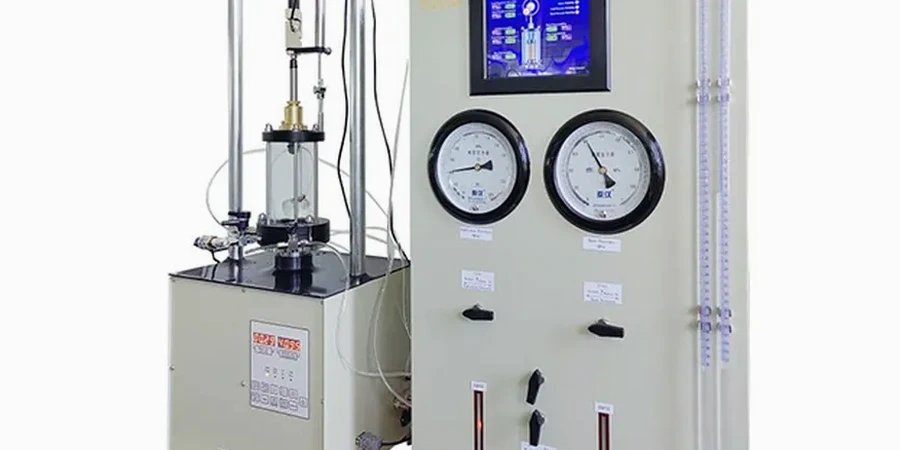
The soil profile changes sharply between Repentigny's older riverfront sectors and the newer developments east of Autoroute 40. Near the L'Assomption River, you hit firm glacial till at shallow depth. Move two kilometers inland, and the Champlain Sea silty clay runs 25 meters deep before reaching competent bearing strata. This contrast means a strip footing design that works perfectly on Rue Notre-Dame demands a completely different set of strength parameters for a project off Boulevard Brien. The triaxial consolidated-undrained test with pore pressure measurement gives us those parameters directly—effective friction angle and cohesion that feed straight into bearing capacity equations under NBCC 2020. Without this data, you end up either over-excavating on good ground or under-designing on the compressible clay that characterizes most of Repentigny's suburban expansion zones.

A triaxial test on Repentigny Champlain clay gives you effective cohesion around 5-15 kPa and friction angles between 22° and 28°—numbers that completely change your foundation dimensions.
Our service areas

Our approach and scope

The Champlain Sea deposited up to 60 meters of sensitive clay across the Lower St. Lawrence region. Repentigny sits right on this marine clay plain. Undisturbed Shelby tube samples from depths of 8 to 18 meters typically show liquidity indices above 1.2 and sensitivity values that raise red flags for any geotechnical engineer. We run consolidated-undrained triaxial tests at confining pressures matching the in-situ overburden stress—usually 100, 200, and 400 kPa for typical foundation depths here. Back-pressure saturation ensures full B-parameters above 0.95 before shearing. For projects near the Mascouche River terraces where sand lenses appear within the clay matrix, the CPT test helps us select the right sampling depths before we extract undisturbed material for triaxial testing. The combined approach reduces uncertainty in the failure envelope by up to 30% compared to correlations from index properties alone.
Triaxial Testing in Repentigny: Shear Strength Parameters for Foundation Design
Technical reference — Repentigny

Local geotechnical context

Winter laboratory conditions in Quebec introduce a risk that few outside the province consider. A Shelby tube extracted at 2°C ambient temperature and transported without thermal protection can freeze at the ends before reaching the lab. Frozen pore water expands, destroys the clay fabric, and renders the sample useless for triaxial testing. We use insulated transport boxes with thermal logging for all Repentigny projects between November and March. The second risk is sample disturbance from tube driving in sensitive clay—Champlain Sea deposits lose up to 70% of their undisturbed strength if the sampler advances too fast. Our field crew follows CSA A23.3 guidelines on push rate and tube diameter ratios. The third issue is delayed testing. Sensitive clays stored more than two weeks show thixotropic strength regain that masks the true in-situ behavior. We prioritize Repentigny samples for immediate extrusion and setup.

Need a geotechnical assessment?

Reply within 24h.

Email: info@geotechnical-engineering.org

Relevant standards

ASTM D4767 – Standard Test Method for Consolidated Undrained Triaxial Compression Test for Cohesive Soils, CSA A23.3 – Design of Concrete Structures (foundation bearing capacity provisions, Section 15), NBCC 2020 – National Building Code of Canada (Division B, Part 4, geotechnical seismic site classification), ASTM D1587 – Standard Practice for Thin-Walled Tube Sampling of Fine-Grained Soils for Geotechnical Purposes

Technical data

ParameterTypical value
Test standard followedASTM D4767 (consolidated-undrained with pore pressure measurement)
Sample condition testedUndisturbed Shelby tube samples (75 mm diameter typical)
Confining pressures applied100, 200, 400 kPa (adjusted to in-situ overburden stress profile)
Effective friction angle range (Champlain clay)22° to 28° (normally consolidated to lightly overconsolidated)
Effective cohesion range (Champlain clay)5 to 15 kPa
Back-pressure saturation targetB-parameter ≥ 0.95 before shearing phase
Typical report turnaround7 to 10 business days for a three-specimen test suite

Questions and answers

How much does a triaxial test cost in Repentigny?

A three-specimen consolidated-undrained test suite on Repentigny clay samples typically runs between CA$2,670 and CA$3,710. The exact price depends on sample depth, whether we handle field sampling or you deliver Shelby tubes to our lab, and the required confining pressure range. Tests on sandy silt lenses from the Mascouche River terraces fall at the upper end due to longer saturation times.

Why does Repentigny's Champlain clay require CU triaxial testing instead of simpler methods?

Champlain Sea clay is sensitive—its structure collapses under shear, generating high pore pressures that simple unconfined compression tests cannot measure. A CU triaxial with pore pressure gives effective stress parameters that let us predict long-term settlement and bearing capacity correctly. Index property correlations from Atterberg limits underestimate the real friction angle by 3 to 5 degrees, which translates to overly conservative or unsafe foundation designs depending on the loading case.

How long does it take to get triaxial test results?

A standard CU triaxial suite with three confining pressures takes 7 to 10 business days from sample extrusion to final report. Saturation alone can require 48 to 72 hours for low-permeability Repentigny clay. UU tests are faster—typically 2 to 3 business days. We can expedite for active construction if you notify us before sampling.

What sample quality do you need for reliable triaxial results?

We need undisturbed Shelby tube samples with an area ratio below 10% and no visible fissures, gravel inclusions, or desiccation cracks. For Repentigny's sensitive clay, the tube must be pushed continuously at a steady rate—hammer-driven samples show disturbance that invalidates effective stress parameters. We inspect every tube upon arrival and reject specimens with end disturbance exceeding 15 mm or evidence of freezing damage.

Location and service area

We serve projects in Repentigny and surrounding areas.

View larger map