GEOTECHNICAL ENGINEERING
REPENTIGNY
HomeGeophysicsSeismic tomography (refraction/reflection)

Seismic Tomography (Refraction/Reflection) for Geotechnical Projects in Repentigny

Technical studies that support your project.

LEARN MORE

Repentigny sits at an elevation of roughly 20 meters above the St. Lawrence River, on unconsolidated sediments of the Champlain Sea that can hide unpredictable bedrock topography. Our field team has applied seismic tomography across dozens of sites along the L'Assomption River corridor, where the contrast between stiff glacial till and underlying shale creates exactly the kind of velocity boundary that refraction surveys resolve. When a recent commercial development near Boulevard Brien encountered 8 meters of soft clay over weathered rock, the seismic refraction profile mapped the bedrock dip in a single morning. That same dataset fed directly into the CPT test layout, positioning soundings where the seismic velocity gradient indicated a transition zone. For deeper targets or urban noise conditions, reflection processing captures horizons beyond 30 meters depth, well past the reach of mechanical borings alone.

A 2D velocity tomogram gives you a continuous image of the subsurface—unlike a borehole that samples a single point.
Our service areas

Our approach and scope

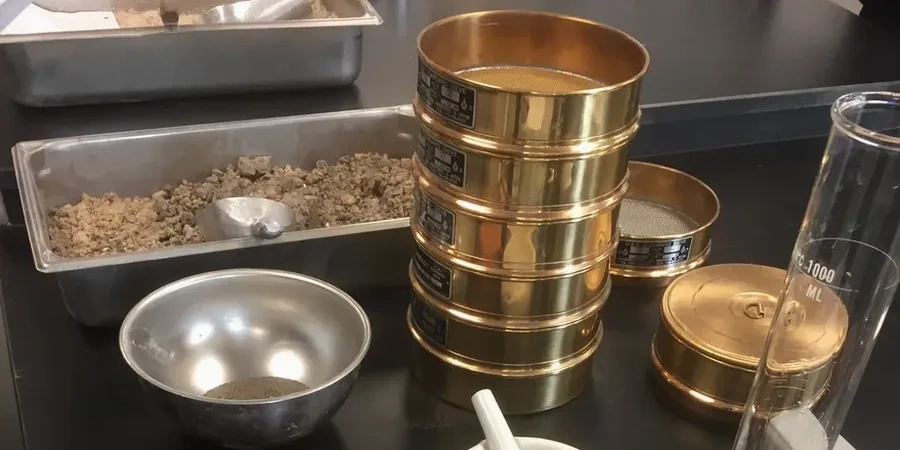
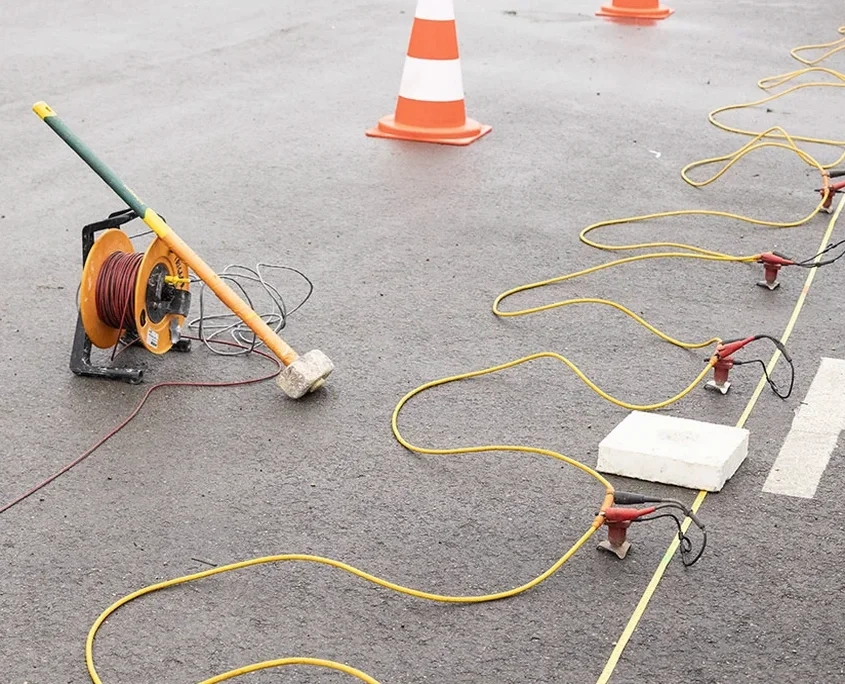
Under the National Building Code of Canada, Repentigny falls within seismic hazard zone 3, requiring site-specific shear wave velocity data for Site Class determination. CSA A23.3 references these values for foundation design in moderate seismicity. Our acquisition uses 24-channel seismographs with 4.5 Hz geophones at 3-meter spacing along lines up to 115 meters. For refraction, we process with the generalized reciprocal method—traveltime picks are inverted iteratively until RMS misfit drops below 1.5 milliseconds. Reflection surveys add common midpoint stacking with nominal 6-fold coverage. The resulting P-wave velocity tomograms routinely achieve 0.5-meter vertical resolution in the upper 15 meters. Where the clay-silt sequence transitions to shale, we often pair this with grain size analysis of cuttings from nearby test pits to calibrate seismic velocities to actual lithology. Velocity cross-sections then integrate with slope stability models when the bedrock surface dips toward an excavation face.
Seismic Tomography (Refraction/Reflection) for Geotechnical Projects in Repentigny
Technical reference — Repentigny

Local geotechnical context

The Champlain Sea clays across Repentigny's low-lying sectors mask an irregular bedrock surface shaped by preglacial erosion channels. Boreholes spaced 20 meters apart can completely miss a 5-meter-deep trough filled with compressible organic silt. That kind of oversight turns a routine footing excavation into a dewatering and over-excavation claim within hours. Seismic tomography bridges the gap—continuous P-wave coverage along the entire alignment flags velocity inversions in real time. A low-velocity channel at 450 m/s surrounded by 1,200 m/s till cannot hide from the ray path coverage of a 115-meter refraction spread. Reflection data adds confirmation at depth when the velocity contrast at the soil-rock interface exceeds a ratio of 2:1. On a recent warehouse project near Rue Notre-Dame, the tomogram revealed a buried channel that geotechnical borings alone had not detected, prompting a redesign of the stone columns grid before mobilization and saving the contractor two weeks of remedial work.

Need a geotechnical assessment?

Reply within 24h.

Email: info@geotechnical-engineering.org

Relevant standards

NBCC 2020 (National Building Code of Canada) – Seismic Hazard and Site Classification provisions, CSA A23.3-19 – Design of Concrete Structures: Foundations in seismic zones, ASTM D5777-18 – Standard Guide for Using the Seismic Refraction Method for Subsurface Investigation, ASTM D7128-18 – Standard Guide for Using the Seismic Reflection Method for Shallow Subsurface Investigation

Technical data

ParameterTypical value
Seismic sourceSledgehammer (8 kg) with steel plate; weight drop for deep targets
Receiver array24-channel, 4.5 Hz vertical geophones, 3 m spacing typical
Maximum investigation depth (refraction)25–35 m depending on velocity contrast and spread length
Maximum investigation depth (reflection)50–80 m with enhanced source energy
Vertical resolution0.5–1.0 m in the upper 15 m; 1.5–2.5 m below 30 m
Velocity range measured200 m/s (soft clay) to >4,500 m/s (competent limestone/shale)
Data deliverables2D P-wave velocity profiles, ray coverage density plots, layered model interpretation, SEG-Y raw data
Relevant standardsASTM D5777, NBCC 2020 Site Classification, CSA A23.3-19

Questions and answers

What is the typical depth range for seismic refraction in Repentigny's soil conditions?

With a 115-meter spread and sledgehammer source, we consistently reach 25 to 30 meters depth in the Champlain clay and glacial till sequence. The limiting factor is the velocity contrast at the top of the shale bedrock—once that high-velocity layer is encountered, refracted arrivals from deeper horizons are masked. For targets between 30 and 80 meters, we shift to reflection acquisition with a weight drop source to boost low-frequency energy.

How much does a seismic tomography survey cost for a typical lot in Repentigny?

For a standard residential or light commercial lot with a single 115-meter refraction line and basic interpretation, budget between CA$3,540 and CA$7,480. The range depends on line length, number of spreads, source type, and whether reflection processing is added. Urban sites with high ambient noise or limited access may require night work or alternative ReMi acquisition, which affects the final figure.

Can seismic tomography distinguish between clay, till, and shale bedrock in Repentigny?

Yes, the velocity contrast is diagnostic. Champlain Sea clays in this area typically register 250 to 500 m/s P-wave velocity. Compact glacial till ranges from 800 to 1,600 m/s. The Utica Shale and Lorraine Group siltstone beneath Repentigny show velocities above 2,800 m/s, often exceeding 3,500 m/s when fresh. The tomogram displays these interfaces as distinct color gradations. We calibrate these boundaries with at least one borehole or test pit to confirm lithology at key velocity transitions.

Location and service area

We serve projects in Repentigny and surrounding areas.

View larger map