GEOTECHNICAL ENGINEERING
REPENTIGNY
HomeUnderground ExcavationsGeotechnical design of deep excavations

Geotechnical Design of Deep Excavations in Repentigny

Technical studies that support your project.

LEARN MORE

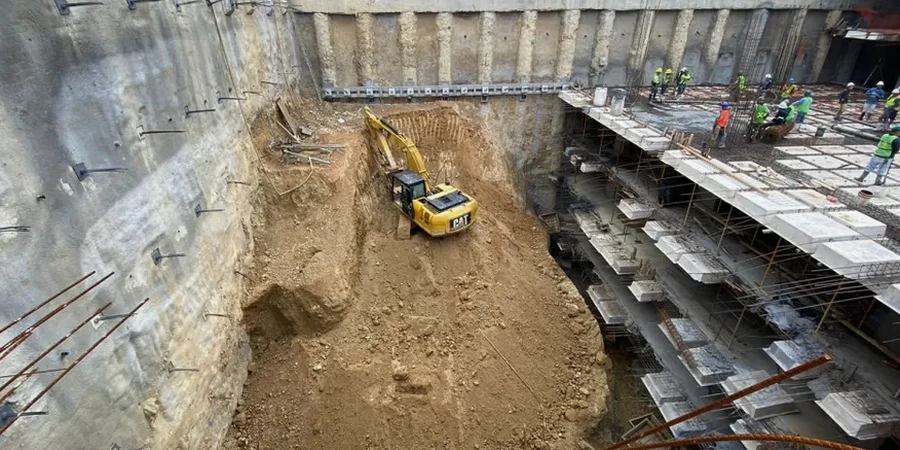
When you excavate below the water table in Repentigny, you are engaging with a subsurface shaped by the retreat of the Champlain Sea nearly 10,000 years ago. The city sits at roughly 10 meters above the St. Lawrence River, underlain by sequences of sensitive marine clays that can lose more than half their strength when remolded. Excavations deeper than 3 meters routinely encounter interbedded silt lenses that channel groundwater from the L'Assomption River plain, creating hydraulic gradients that complicate open-cut methods. In our experience across the Lanaudière region, a deep excavation design that works in the till of the Canadian Shield, just north of the city, will fail catastrophically in the Champlain clays of the southern neighborhoods unless the anisotropic consolidation stress history is explicitly modeled. We integrate piezocone data from CPT testing with laboratory triaxial paths to define the undrained shear strength profile that governs the temporary shoring sequence. Our approach respects the 2010 NBCC seismic hazard values, which mandate a design spectral acceleration that accounts for the moderate seismicity of the Western Quebec Seismic Zone, and aligns with the deep foundation requirements of CSA A23.3.

In Repentigny's Champlain clays, the design of a deep excavation is governed not by the intact peak strength but by the remolded residual strength after strain softening.
Our service areas

Our approach and scope

A recent project near the Centre d'Interprétation de la Nature involved a 7.5-meter cut for an underground parking structure within 40 meters of the Rivière L'Assomption. The water table sat at just 1.8 meters below grade, and the geotechnical profile revealed a 4-meter crust of desiccated brown silty clay over a thick unit of soft, grey, extra-sensitive clay with liquidity indices above 1.5. The excavation support system required a secant pile wall with a continuous jet-grouted toe to cut off the basal hydraulic connection to the river, which fluctuates seasonally by over 1.2 meters. We ran coupled flow-deformation analyses in PLAXIS 2D, calibrating the Hardening Soil model parameters against consolidated-undrained triaxial tests with pore pressure measurement on Shelby tube samples. The design incorporated staged excavation of no more than 1.5 meters before ring beam installation, with real-time inclinometer verification at three sections along the wall. The strut preloads were set to 70% of the calculated apparent earth pressure, a value we have validated through monitoring on five similar Repentigny projects over the past decade.
Geotechnical Design of Deep Excavations in Repentigny
Technical reference — Repentigny

Local geotechnical context

The drill rig used to install soldier piles or secant walls in Repentigny must contend with artesian pressures that can develop in the basal sand unit underlying the clay. We typically specify a fully cased drilling method with a minimum 900 mm casing advance ahead of the auger to prevent hydraulic breakthrough. In our monitoring data from the Le Gardeur sector, a single unsealed borehole intersecting a confined aquifer at 14 meters depth triggered a 60 mm settlement trough extending 25 meters from the excavation perimeter before grouting sealed the conduit. The primary risk is not just basal heave, which we check using the modified Terzaghi factor against the average undrained shear strength from field vane tests, but also the progressive loss of passive resistance in the toe when the clay is allowed to freeze-thaw cycle during winter construction. We require a thermal protection berm or heated enclosure for any open excavation face between December and March, a lesson reinforced by a 2018 wall kick-out incident in Repentigny during a rapid cold snap.

Need a geotechnical assessment?

Reply within 24h.

Email: info@geotechnical-engineering.org

Relevant standards

NBCC 2010 (National Building Code of Canada, seismic provisions), CSA A23.3-14 (Design of concrete structures), CFEM (Canadian Foundation Engineering Manual, 4th Ed.), ASTM D7181 (Consolidated drained triaxial compression test for soils)

Technical data

ParameterTypical value
Maximum excavation depth evaluated25 m (with internal bracing)
Typical shoring system stiffnessEI = 80,000–350,000 kN·m²/m
Design groundwater cutoffJet grout or slurry wall to bedrock
Clay sensitivity (St) range15–45 (Champlain Sea unit)
Seismic coefficient (kh)0.08–0.14 per NBCC 2010
Allowable wall deflection (H/ratio)H/300 to H/500 (adjacent structures)
Strut preload percentage65–80% of apparent earth pressure

Questions and answers

What is the cost range for a deep excavation geotechnical design in Repentigny?

For a complete design package—including a geotechnical interpretive report, shoring wall structural calculations, and a 2D finite element deformation analysis—the fee typically ranges from CA$2,730 for a straightforward single-level cut to CA$11,830 for a complex multi-braced excavation near existing infrastructure. The final cost depends on the depth, the proximity of adjacent buildings, and the number of construction stages requiring detailed analysis.

How do you account for the sensitive Champlain clay in the excavation design?

We characterize the clay through a combination of field vane shear tests, CPTu pore pressure dissipation tests, and laboratory fall cone and triaxial tests. The design explicitly uses the remolded undrained shear strength when evaluating post-peak stability, and we apply a strain-softening reduction factor calibrated to the measured sensitivity (St) of the deposit, which in Repentigny often ranges from 15 to 45.

Do you need to consider seismic loading for temporary excavations?

Yes. The NBCC 2010 requires a seismic check for any excavation that remains open for more than a few weeks, particularly in the moderate seismicity of the Western Quebec Zone. We apply a pseudo-static lateral earth pressure increment using a horizontal seismic coefficient (kh) derived from the site-specific spectral acceleration at a 2% in 50-year probability of exceedance.

What is the typical permit submission timeline for a deep excavation design in Repentigny?

A complete geotechnical submission for a building permit in Repentigny generally requires 4 to 6 weeks from the completion of the field investigation to the delivery of stamped drawings and a calculation package. This includes time for laboratory testing, finite element modeling, and an internal peer review by a second senior engineer familiar with the local Champlain Sea stratigraphy.

How do you prevent bottom heave in deep clay excavations?

We evaluate the factor of safety against basal heave using the modified Terzaghi method, with the undrained shear strength averaged over the failure surface. If the factor is below 1.5, we implement a jet-grouted base plug, extend the wall into a deeper stiff till unit, or install tension piles to anchor the slab against uplift, depending on the thickness of the soft clay layer at the site.

Location and service area

We serve projects in Repentigny and surrounding areas.

View larger map