GEOTECHNICAL ENGINEERING
REPENTIGNY
HomeIn-Situ TestingField density test (sand cone method)

Field Density Testing in Repentigny: Sand Cone Method for Compaction Verification

Technical studies that support your project.

LEARN MORE

Repentigny's transformation from an 18th-century seigneurie on the Assomption River into a modern Montréal suburb has placed increasing demand on its underlying Champlain Sea clay. The city, home to over 86,000 residents, sits on a terrace where the soils transition sharply from dense till in the north to sensitive marine silts near the river. This geological reality means that even a well-graded granular fill can settle unevenly if compaction isn't verified on site. Our team runs the field density test using the sand cone method to confirm that backfill placed around foundations, behind retaining walls, or beneath slab-on-grade construction in Repentigny meets the specified relative compaction before concrete is ever poured. A CPT test often helps us profile the native clay before fill placement begins, giving a clear picture of what lies beneath the compacted lift.

A single sand cone test in Repentigny's marine clay backfill can reveal whether the contractor achieved 95% Standard Proctor before the next lift buries the evidence.
Our service areas

Our approach and scope

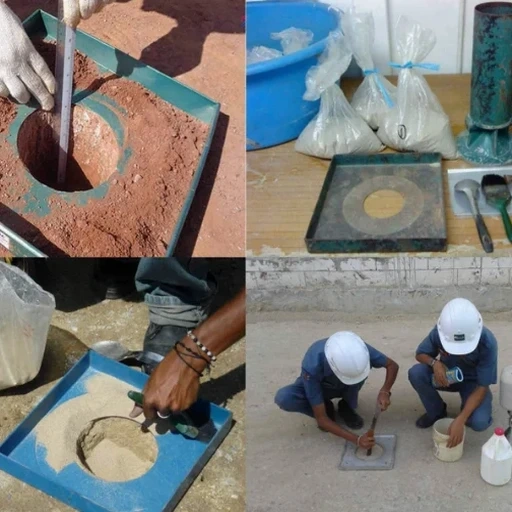
In Repentigny, we frequently encounter imported fill that arrives from quarries in the Laurentians, and its grain size distribution can vary noticeably from one truckload to the next. The sand cone test lets us quantify the in-place dry density layer by layer, typically checking every 300 mm of compacted thickness in building pads and every 150 mm in utility trenches. We calibrate the procedure to ASTM D1556, using Ottawa sand that has been dried and graded through our laboratory's ISO 17025-accredited system. The method is disarmingly simple: a small hole is excavated, the removed soil is weighed and tested for moisture content, and the hole's volume is measured by backfilling it with the calibrated sand. Yet the results carry enormous weight, because a difference of just 2% in compaction can separate a pavement that lasts fifteen years from one that fails after the second freeze-thaw cycle. For road building, we often pair the sand cone with a CBR test to correlate field density with bearing capacity before the asphalt goes down.
Field Density Testing in Repentigny: Sand Cone Method for Compaction Verification
Technical reference — Repentigny

Local geotechnical context

The contrast between Repentigny's northern sector, which rests on dense glacial till with excellent bearing, and the low-lying areas near the Assomption River, where Champlain Sea clay dominates, is something every local contractor learns to respect. On the till, a few quick passes with a vibratory roller often hit spec, and the sand cone simply confirms what the operator already felt. Along the river, however, the native clay beneath the fill can be so sensitive that overcompaction of the granular layer above triggers pore pressure buildup in the subgrade. We have seen projects where a poorly timed density test, taken immediately after rolling without allowing the clay to drain, gave a false pass that later led to differential settlement and cracked floor slabs. The field density test becomes a diagnostic tool, not just a checklist item, when the soil profile shifts every hundred metres. A single uncompacted lift in a sewer trench crossing from till into clay can create a hard spot that attracts frost and ruptures the pipe within three winters.

Need a geotechnical assessment?

Reply within 24h.

Email: info@geotechnical-engineering.org

Video overview

Relevant standards

ASTM D1556: Standard Test Method for Density and Unit Weight of Soil in Place by Sand-Cone Method, ASTM D1557: Standard Test Methods for Laboratory Compaction Characteristics of Soil Using Modified Effort, ASTM D2216: Standard Test Methods for Laboratory Determination of Water (Moisture) Content of Soil and Rock by Mass, CAN/BNQ 2501-060: Soils - Determination of the In-Place Density and the Moisture Content of Soils by the Nuclear Method (alternative reference), NBCC 2015: National Building Code of Canada, Section 4.2 on excavations and backfill

Technical data

ParameterTypical value
Test standardASTM D1556 / ASTM D1557
Calibrated sand type20-30 Ottawa sand, oven-dried
Minimum test depth100 mm below compacted surface
Typical lift thickness verified150-300 mm
Moisture content methodASTM D2216 (oven-dry)
Compaction referenceStandard or Modified Proctor
Acceptance criterion (structural fill)≥95% Standard Proctor
Hole volume accuracy±1% with calibrated sand cone

Questions and answers

How much does a sand cone density test cost in Repentigny?

A single sand cone test typically runs between CA$160 and CA$180 when performed as part of a larger quality-control program. The rate covers the technician's time on site, the excavation and measurement, moisture content determination in our laboratory, and a signed report. Volume discounts apply when we deploy a technician for a full day of testing on larger subdivisions or road projects.

How many sand cone tests are required on a typical house foundation backfill?

For a single-family home in Repentigny, the geotechnical specification usually calls for one test per lift per 150 m2 of compacted area, or at least one per foundation wall. The exact frequency is set by the project's geotechnical engineer based on the NBCC and the variability of the fill material.

Can you perform the sand cone test in winter conditions?

Yes, but frozen fill cannot be compacted to specification, so the test is only valid when the material is unfrozen. We use heated sand and insulated containers to keep the Ottawa sand flowing freely at sub-zero temperatures, and we measure moisture content immediately to avoid freezing before the sample reaches the lab.

Location and service area

We serve projects in Repentigny and surrounding areas.

View larger map