GEOTECHNICAL ENGINEERING
REPENTIGNY
HomeSlopes & WallsRetaining wall design

Retaining Wall Design in Repentigny: Technical Considerations for the Lanaudière Region

Technical studies that support your project.

LEARN MORE

A total station and a laser level are usually the first tools we set up on a Repentigny site when a retaining wall is in the design phase. The reason is simple: the terrain here rarely tells the whole story from a simple visual inspection. The Lanaudière region, with Repentigny sitting on the north shore of the St. Lawrence River at roughly 45.73°N, presents a landscape shaped by ancient marine incursions. This means the surficial geology is dominated by sensitive clay deposits that can extend several meters deep before hitting competent till or bedrock. Before we sketch a single cross-section, we need to understand how these low-permeability silts will react to seasonal water fluctuations and lateral earth pressures. It is not just about holding back soil; it is about designing a structure that works with the natural drainage patterns of the Rivière l'Assomption watershed, which directly influences groundwater levels across much of the municipality.

A retaining wall on the north shore is only as reliable as its drainage system during the March thaw.
Our service areas

Our approach and scope

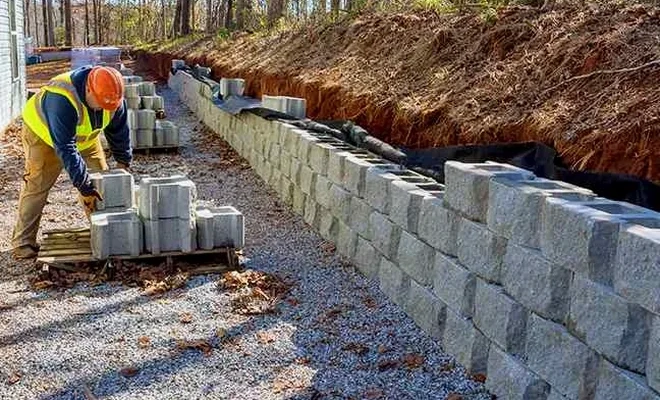
What we observe repeatedly in Repentigny is that a standard gravity wall detail, imported directly from a catalogue without site-specific adaptation, becomes a liability within the first five years. The freeze-thaw cycles here are aggressive, with a frost penetration depth that the NBCC mandates at over 1.4 meters. When a wall lacks proper drainage behind it, the saturated backfill freezes, expands, and gradually pushes the structure out of alignment. In our experience, the most effective approach combines a solid filter layer with a grain-size analysis of the native soil to confirm compatibility with the drainage aggregate. This prevents clogging and ensures the weep holes actually function during the spring melt. For taller walls, cantilevered reinforced concrete designs with an integral footing key become necessary, especially where the slope above the wall is steep. We also evaluate the need for a granular pad beneath the base to manage differential settlement, given the compressibility of the local Champlain Sea clays.
Retaining Wall Design in Repentigny: Technical Considerations for the Lanaudière Region
Technical reference — Repentigny

Local geotechnical context

The NBCC 2015, complemented by the Canadian Foundation Engineering Manual, forms the backbone of every retaining wall design we produce for Repentigny, and for good reason: the seismic hazard here is not negligible. The city lies within a region of moderate seismicity linked to the Western Quebec Seismic Zone. A wall that appears perfectly stable under static conditions can experience a sudden increase in lateral earth pressure during a seismic event, leading to a rotational failure if the factor of safety was not properly calculated for dynamic loading. The sensitive clays add another layer of complexity; if these soils are disturbed or subjected to excessive vibration without proper reinforcement, they can lose significant strength. That is why we perform rigorous global stability checks, particularly for walls located near the top of riverbanks or slopes, using Spencer's method or similar limit equilibrium procedures to ensure the design meets the minimum safety factors required by the code for both short-term and long-term conditions.

Need a geotechnical assessment?

Reply within 24h.

Email: info@geotechnical-engineering.org

Relevant standards

NBCC 2015 (National Building Code of Canada), CSA A23.3:19 (Design of Concrete Structures), Canadian Foundation Engineering Manual, 4th Edition, ASTM D698 (Standard Proctor for backfill compaction)

Technical data

ParameterTypical value
Typical wall height range1.2 m to 6.5 m (residential to embankment)
Frost penetration depth (design)> 1.4 m (per NBCC climate data)
Backfill friction angle (granular)32° to 38° (compacted crushed stone)
Surcharge load (residential)Minimum 2.4 kPa (or vehicle load)
Design life (permanent walls)50 to 75 years (CSA A23.3 exposure)
Drainage aggregate specification20 mm clear crushed stone, wrapped in geotextile

Questions and answers

What is the typical cost range for a retaining wall design in Repentigny?

For a residential or light commercial project in the Lanaudière region, the engineering design for a retaining wall typically falls between CA$1,560 and CA$5,800. The final fee depends on the wall height, the complexity of the soil profile, and whether a full slope stability assessment is required by the municipality.

How does the clay soil in Repentigny affect a retaining wall?

The Champlain Sea clay deposits found across Repentigny are generally low-permeability and can be sensitive. This creates two main challenges: poor natural drainage, which builds up hydrostatic pressure behind the wall, and a risk of long-term settlement under the wall's weight. Our designs address this with enhanced drainage systems and, where necessary, a deeper foundation key or a granular replacement pad to distribute loads more evenly.

What height of retaining wall requires a permit and professional design?

While minor landscaping walls under 1.0 meter might not always trigger an engineering review, the Ville de Repentigny's urban planning by-laws generally require a sealed design from a professional engineer for any retaining structure exceeding 1.2 meters in height, or any wall supporting a surcharge such as a driveway or building. We manage the full process, from the initial geotechnical investigation to the submission of the stamped drawings.

Location and service area

We serve projects in Repentigny and surrounding areas. More info.

View larger map